
Why Safety Devices Matter in Gate Automation


Gate automation is one of those installations where the risk is easy to underestimate. A motorised gate is heavy, often several hundred kilograms of steel, and the motor moving it doesn't know whether a child, a car bonnet, or a dog is in the way. Safety devices supply that awareness. Without them, a convenience feature can become a crushing hazard.
Why They Matter
The main danger is entrapment and impact. Swing gates can pin someone against a wall or pillar. Sliding gates create pinch points at the rollers, the gear rack, and the gap where the gate meets the post. Most serious gate accidents involve children playing near the gate, pedestrians walking through as it closes, or vehicles that stop in the gate's path.

There are practical reasons beyond injury too. Stopping on obstruction protects cars from dents and scratched paint, and it protects the gate, motor, and gearbox from strain. For homeowners and estate managers, correctly fitted safety features also reduce liability and support insurance claims.
The Key Safety Devices
Photocells
Photocells are usually the first line of defence. A transmitter and receiver on either side of the opening send an infrared beam across it. If anything breaks the beam while the gate is closing, the controller stops or reverses the gate. Fitting two pairs, one at bumper height and one lower for children and pets, gives much better coverage than a single pair.


Safety Edges
Safety edges are pressure-sensitive rubber strips mounted on the leading edge of the gate. On contact, they signal the controller to reverse immediately. They cover situations photocells can miss, such as someone standing close to the post.Obstacle Detection and Force Limiting

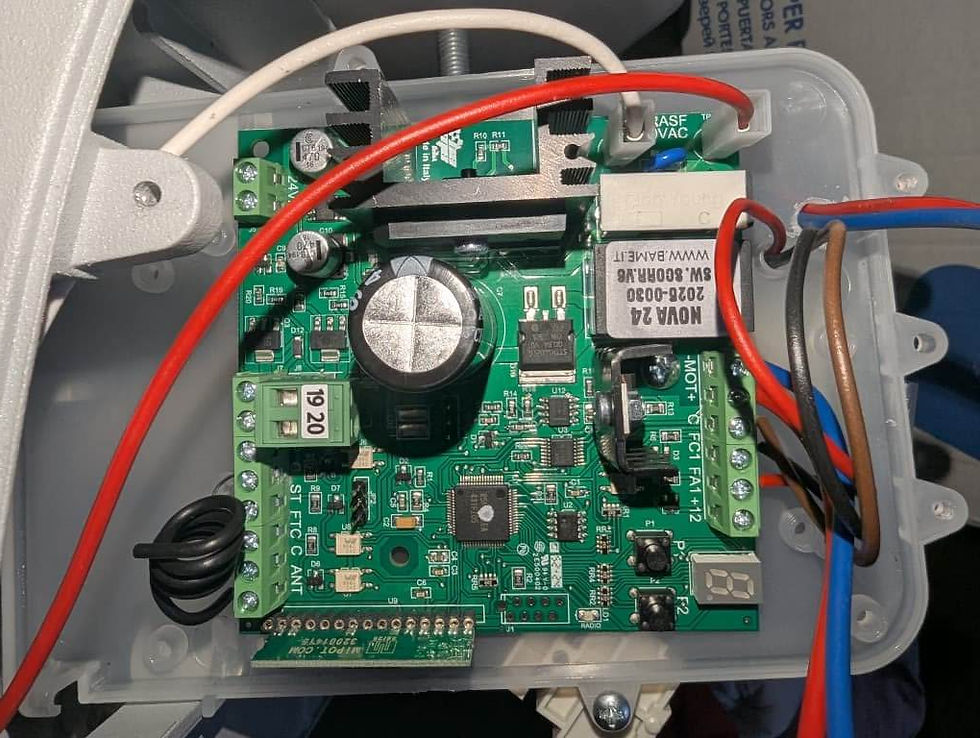
Most quality control boards monitor motor current or torque and reverse the gate when resistance rises unexpectedly. This must be set properly during commissioning. Set too high, it won't protect anyone. Set too low, the gate stops for no reason.

Flashing Lights and Warning Beacons
Warning lights alert people nearby that the gate is about to move. This matters most at night and for pedestrians who aren't paying attention.
Vehicle Loop Detectors
Induction loops cut into the driveway sense a car sitting in the gate's path and stop the gate from closing on it. They're common in estates and commercial sites with heavy traffic.
Limit Switches
Limit switches tell the motor exactly where fully open and fully closed are, stopping the gate from overrunning and damaging itself or the structure.
Manual Release and Backup Power
If there's a power failure or the motor breaks down, people must still be able to open the gate, for example during a fire or medical emergency. A key-operated release, together with battery backup or a solar or inverter link, keeps the gate usable when grid power is unreliable.


Physical Guarding
Covers over rollers and gear racks, mesh on the lower section of open-bar gates so small hands can't reach through, and minimal gaps at pinch points complete the picture.
Standards to Know
International standards such as EN 12453 in Europe and UL 325 / ASTM F2200 in the US require automated gates to have entrapment protection, typically at least two independent safety methods. Professional installers use these as a benchmark even where local regulation is less specific.
Maintenance: Keeping Safety Devices Working
A safety device that isn't maintained offers little real protection. Photocell lenses collect dust and cobwebs, brackets get knocked out of alignment, and force settings drift as gates wear.
A simple routine helps: walk through the photocell beam, press the safety edge, confirm the gate reverses on obstruction, and check the manual release. Do this monthly, with professional servicing every six to twelve months.
Conclusion
The motor makes the gate convenient, but the safety devices make it safe to live with. If your gate was installed without proper safety features, or hasn't been serviced in a while, get it inspected.

Sterling Magna Technologies installs and services automated gates across Ajah, Lekki, Victoria Island, and VGC. Contact us to book a safety inspection.


Comments