
How to Choose the Right Fingerprint Smart Lock for Your Door Type


A practical guide for homes and offices in Lagos
A fingerprint lock is the fastest, most convenient way to secure a door. No keys to lose, no codes to forget, no copies floating around with a former staff member.
But the lock that works beautifully on your neighbour's wooden door may not fit yours at all — and the wrong choice usually means a damaged door before you find out. This guide starts where the decision actually starts: with your door.
Step 1: Identify Your Door
Everything else follows from this. Find yours below
Steel security doors. The standard exterior door in most Lagos estates — Lekki, Ajah, VGC. Almost always pre-cut for a mortise lock body, usually with a 60mm or 70mm backset. Best option: a full mortise fingerprint handle-set. Do not try to surface-mount onto one.
Wood-grain steel doors. Increasingly common — a steel security door with a wood-grain finish and applied trim. It looks like timber but behaves like steel, so follow the steel security door guidance above. Tap it: a metallic ring rather than a solid thud means steel underneath.
Metal security gates. The slat or bar gate in front of the main door. These take a fingerprint lock, but the vertical stile is narrow — usually 30–45mm — so you need a narrow-body mortise. Covered in more detail further down.
Solid wooden doors. Flush or panelled timber, usually interior, boys' quarters, or older builds. The most flexible category — mortise, rim, or deadbolt-style all work, provided the door is genuinely solid.
Moulded panel doors (HDF). The moulded interior door in most newer builds. Looks like solid timber but is usually hollow-cored. Knock on it — if it sounds hollow, a mortise lock will not hold without reinforcement. Use a surface-mounted rim lock instead.
Aluminium doors. Common on side entrances, balconies, and rear access. Hinged aluminium doors take a narrow-body mortise lock without difficulty — measure the stile first. Sliding aluminium doors need a hook-bolt lock made specifically for sliders; these exist but are a specialty item, so ask about availability before planning around one.
Frameless glass doors. Common on office entrances, shopfronts, and some residential main doors. These take a patch-fitting lock that clamps above and below the glass — nothing is drilled into the panel itself. Confirm your glass thickness first, usually 10mm or 12mm. Video locks fit these well, since a glass entrance is often where you most want to see who's outside before opening.
Double doors. Estate entrances, event halls, church doors. You lock the active leaf and secure the inactive leaf separately with flush bolts top and bottom. One fingerprint lock is enough; you don't need two.
One less common case: uPVC doors, mostly on imported builds, need a narrow-body mortise like aluminium. Workable — ask us if that's what you have.

Step 2: Measure Before You Order
This is the step people skip, and it's the one that causes the damage.

Take three measurements and write them down:
Door thickness. Measure the edge of the door leaf, not the frame. Most fingerprint locks accommodate 40–70mm; some go to 100mm with an extension kit. Nigerian steel doors are usually 40–50mm.
Backset. The distance from the door edge to the centre of the handle spindle. The two common sizes are 60mm and 70mm. Some locks ship adjustable; most don't.
Stile width. The width of the vertical member holding the lock. Critical for aluminium doors and security gates. Under 40mm means you need a narrow-body lock.
If your door is already cut for a lock, also measure the existing mortise pocket — depth, height, and the centre distance between the spindle hole and the cylinder hole. Matching an existing pocket saves you a fresh cut.
Step 3: Check Your Door Can Take One At All
Not every door can carry a fingerprint lock. Check yours against this list before you spend money — some of these problems only appear after the cut is made, and by then the door is damaged.
Hollow-core and moulded HDF doors. The most common disqualifier in newer builds. They look like solid timber, but the interior is honeycomb or hollow. A mortise cut removes what little structure exists and the screws pull loose within months. Knock on the door: a hollow sound means you need internal reinforcement or a surface-mounted rim lock.
Doors thinner than about 35mm. Most lock bodies need 40mm minimum. Below that the through-bolts won't seat and the faceplate stands proud of the edge.
Stiles narrower than about 28mm. Even a narrow-body lock has a limit. This catches slim aluminium casement doors and lightweight gates.
Warped or misaligned doors. If your current lock already sticks, or you have to lift the door to close it, a fingerprint lock will be worse — a motorised bolt has less force than your hand. Fix the alignment first.
Louvred and open-slat doors with no solid stile. Some decorative gates and vent doors have nothing wide enough anywhere along the leaf to hold a lock body.
Doors with damaged or oversized existing cutouts. If a previous lock was forced in and the pocket is now too large, no faceplate will cover it. The door needs repair or replacement first.
Untreated timber that swells. A door that binds every rainy season will bind worse with a powered bolt. Seal and hang it properly first.
If your door is on this list, you have three options: reinforce or repair it, fit a surface-mounted rim lock instead of a mortise, or replace the door. Send us a photo of the door edge and we'll tell you which applies.
Step 4: Understand the Fingerprint Sensor
Not all fingerprint readers behave the same way, and in this climate the difference matters.
Semiconductor (capacitive) sensors read the electrical properties of your fingerprint ridges. They cope better with damp fingers, worn prints, and dust, and they're much harder to fool with a lifted print. This is what you want on an exterior door in Lagos.
Optical sensors photograph the finger surface. Cheaper, but they struggle with wet hands in the rainy season and dry, dusty fingers in harmattan. Acceptable on interior and low-traffic doors.
Other specifications worth checking:
Enrollment capacity — 20 to 100+ prints. Register two fingers per person, so a family of five needs at least ten slots.
Recognition time — under one second is normal. Anything slower gets irritating fast at a front door.
Backup methods — every good lock has at least two: a keypad code and a mechanical key override.
False rejection — no sensor is perfect. Children and older adults with faint prints often need the keypad as their primary method. Plan for it.
Step 5: Power, Backup, and the Realities of NEPA
Fingerprint locks are battery-powered, which is an advantage here — the lock keeps working through an outage.
Expect 6–12 months from four AA alkaline batteries under normal household use. The lock warns you well before they die, usually with a beep and a voice prompt for weeks in advance.
Every lock worth buying has an emergency USB-C power port on the outside face. If the batteries die completely while you're out, a power bank gets you in. Keep the mechanical override key somewhere off-site — with a neighbour or in your car — not inside the house.
Wi-Fi connectivity is optional. It allows remote unlocking and an access log, but drains batteries faster and depends on your router staying up. For most homes, Bluetooth plus the keypad is enough. Offices with staff turnover benefit more from remote code management.
Step 6: Security Features That Actually Matter
Anti-peep code entry lets you type random digits before and after your real PIN, so anyone watching can't read it off your hand.
Auto-lock engages the bolt a set number of seconds after the door closes. Turn it on.
Tamper alarm sounds if the lock is forced or the faceplate is pried.
Lockout after failed attempts — the lock should freeze for a period after several wrong tries.
Mechanical override — a physical key cylinder, ideally recessed and covered.
Ignore anything offering app access with no keypad and no key. One dead phone and you're locked out of your own house.
Step 7: Installation
Some fingerprint locks are genuinely DIY on a door that's already correctly prepped. Most are not.

A steel door needs the mortise pocket cut and the through-holes drilled to within a millimetre or two. Get it wrong and you can't undo it — you've either got a lock that binds, a bolt that never fully throws, or a hole too large for any faceplate to cover.
Call a professional for: any steel or metal-clad door, a security gate, an aluminium or narrow-stile door, any door not already cut for a lock, or a door where the frame and leaf are out of alignment. Misalignment is the single most common cause of a "faulty" lock that turns out to be perfectly fine.
What About the Security Gate in Front?
Most homes here have two barriers at the entrance: the security gate outside and the main door behind it. If you're fitting a fingerprint lock, the obvious question is whether it goes on one or both.

Yes, the gate can take a fingerprint lock. It's a common fit, and for many households it's the more useful of the two — you come home, open the gate without keys, and the main door stays on its existing lock.
The constraint is the stile. On a slat or bar gate, the vertical member holding the lock is often only 30–45mm wide. That rules out a standard mortise body entirely. You need a narrow-body lock, and you need to measure that member before ordering — not after the lock arrives.
Weather is the other consideration. A gate lock sits fully exposed to sun and rain, unlike a main door under a porch. Look for an IP rating of at least IP55, a metal faceplate rather than plastic, and a cover over the keypad. Expect shorter battery life than an indoor-facing lock, and check the seals during harmattan when dust gets into everything.
Gate or door, or both? If you're choosing one, most people get more daily value from the gate — it's the barrier you open most often, usually with your hands full. Locking both gives you layered security and lets you leave the gate on a temporary code for a visitor while the door stays locked. It also means two sets of batteries and two enrollment lists to manage.
One practical warning: gates move. Wind, settling posts, and daily slamming pull the frame out of true, and a lock that engaged perfectly at installation can start binding months later. That isn't a fault in the lock — it's alignment, and it's adjustable. Have the strike checked once a year.
Quick Reference: Matching a Lock to Your Door
Your door | Lock type you need | Watch out for |
Steel security door | Mortise handle-set | Confirm 60mm vs 70mm backset |
Metal security gate | Narrow-body mortise, IP55+ | Measure stile; check alignment yearly |
Solid wooden door | Mortise or deadbolt style | Confirm it isn't hollow-core |
Moulded HDF panel door | Rim / surface-mount | Needs reinforcement for a mortise |
Aluminium (hinged) | Narrow-body mortise | Measure stile width first |
Aluminium (sliding) | Hook-bolt slider lock | Specialty item — check availability |
Double doors | One mortise + flush bolts | Secure inactive leaf separately |
Frameless glass | Patch fitting | Confirm 10mm or 12mm glass |
What We Recommend and Install
We only list what we actually stock, install, and support in Lagos. Prices below are supply and installation, current as of September 2026 — hardware costs move with the exchange rate, so contact us for a firm quote.
Standard Fingerprint Locks
Every lock we install opens four ways: fingerprint, keypad code, access card, and a mechanical key as the final backup. The differences below are about build, fit, and what suits your door.

Narrow-body gate lock — ₦150,000
Built for the narrow vertical stile on a security gate or slim aluminium door, where a standard lock body physically will not fit. Weather-exposed position, so it comes with a metal faceplate. The most common first install we do, because the gate is the barrier you open most often.
Suits: metal security gates, aluminium hinged doors, narrow-stile frames

Standard mortise handle-set — ₦180,000
Our workhorse for solid doors. Fingerprint sensor at the handle base with the touch keypad above. Fits a standard mortise pocket, so on a door already cut for a lock, the install is straightforward.
Suits: solid wooden doors, steel security doors

Slim-profile mortise — ₦180,000
Same mechanism as above in a narrower faceplate. Worth choosing where the door has a narrow lock stile, or where you want the hardware to sit discreetly against a timber or feature door.
Suits: timber-slat doors, panelled doors, narrow stiles on hinged doors
Video Smart Locks
Same four access methods, plus a built-in camera — you see who is at the door before you open it.
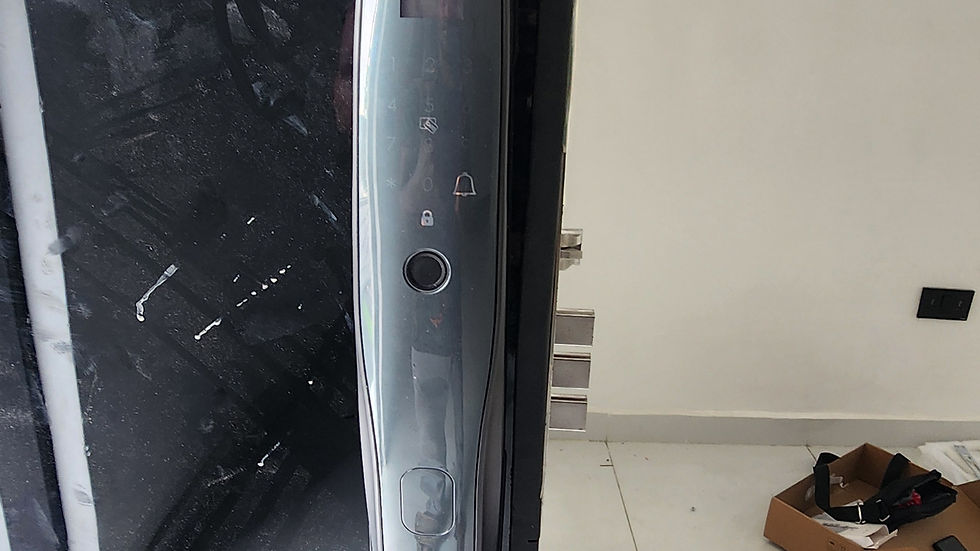
Video smart lock with display — ₦250,000
Full-height faceplate with a camera, a small display, and an illuminated fingerprint ring. You get a live view and a notification when someone approaches, plus every access method the standard locks offer. The display shows status and greetings at the door itself.
Suits: glass entrance doors, steel doors, main residential entrances

Video smart lock, premium build — ₦280,000
Our top specification. Heavier build and the most robust finish we stock, with the camera and full multi-user access management. Worth the step up where the door sees heavy daily traffic, or where you're managing access for staff and tenants rather than one household.
Suits: steel security doors, main entrances, offices and serviced apartments
Which One Should You Get?
If you want one lock and the simplest decision: the standard mortise at ₦180,000 on your main door, or the narrow-body at ₦150,000 .
Step up to a video lock if you want to see who is at the door before opening it — most useful on a main entrance, or anywhere you're managing access for more than a household.
Every price includes the site survey, the cut, strike alignment, and enrolling every user before we leave.
The Short Version
Identify your door type first. Measure thickness, backset, and stile width before ordering anything. Check your door can actually take a lock — hollow-core and moulded doors are the usual disappointment. Choose a semiconductor sensor for exterior doors. Insist on both a keypad and a mechanical key as backups. If you have a security gate, it can take a lock too, but you'll need to measure that narrow stile carefully.
And on any steel, aluminium, or gate installation, have it fitted properly. The door costs far more than the labour.
Not sure which lock suits your door? Send us a photo of the door edge and the lock area, and we'll tell you what fits.


Comments